Manufactured spending tools
Nine cards a week turns into a hundred and eighty cards a season. The people who lose money at this rarely lose it on the math — they lose it on a card they forgot they had, a $4.63 residual nobody drained, or a receipt they couldn't produce.
None of this is exotic. It's organisation, and it's the difference between a hobby that pays and one that quietly leaks. If you only take one thing from this page, take the barcode reader — it turns half an hour of typing card numbers into about a minute, and removes the typos that make a card unfindable later.
What actually goes wrong
- Orphan balances. A $200 card used for a $195.37 money order leaves $4.63. Fifty cards a season and that's a couple of hundred dollars sitting in plastic.
- Losing track of which card is spent. Every card looks identical. There is no visual difference between a drained card and a live one.
- Not being able to prove a purchase. When a card arrives dead, or a balance vanishes, the issuer's first question is for the receipt and the activation slip. No receipt, no resolution.
- Losing the count against the 5x cap. The Ink Cash bonus stops at $25,000 a year. Spend past it at 1x and you've done the errands for nothing.
Organisation — the physical side
The community standard, and it has been for years: baseball card binder pages. Nine pockets to a sheet, gift cards are almost exactly trading-card sized, and a full sheet is a full day's buy. Front of the binder for live cards, back for drained ones pending the receipt window.
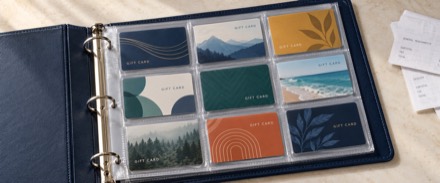
Baseball card binder pages
Nine pockets per sheet, and a gift card fits a trading-card pocket almost exactly. A sheet holds one day's Staples limit. Cheap, and the single highest-value thing on this page.
Find on Amazon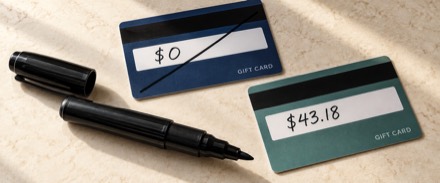
Fine-tip permanent marker
Write the remaining balance on the card the moment you use it, and strike it through when drained. Sounds primitive; it's what experienced people actually do, because the card and its status never get separated.
Find on Amazon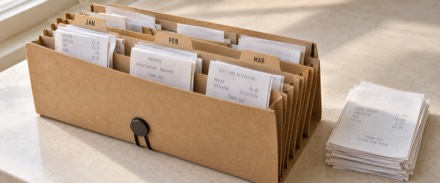
Accordion file or document box
Receipts and activation slips, filed by month. Keep them until the card is fully drained and the statement has posted — that's the window in which you might need to prove anything.
Find on Amazon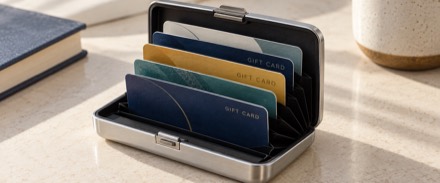
RFID-blocking card case
A hard case beats a rubber band: cards don't bend, the mag stripe doesn't scuff, and you're not carrying $1,800 of bearer instruments loose in a pocket.
Find on Amazon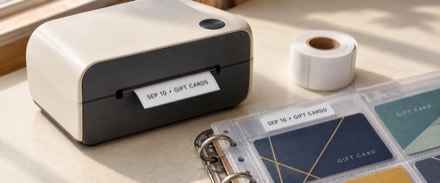
Label printer
If you run volume, labelling binder sheets by purchase date and store beats handwriting. Also handy for money order records.
Find on Amazon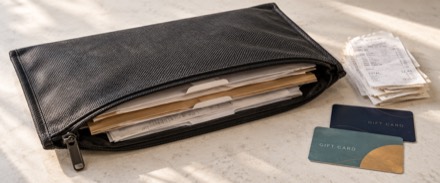
Fireproof document bag
For receipts you're holding across a tax year, and for cards awaiting a dispute. Not essential — but neither is losing the evidence for a $200 claim.
Find on AmazonGetting the numbers in — scan, don't type
This is the one that saves the most time and the most mistakes. Thirty cards typed by hand is thirty chances to transpose a digit, and a wrong digit means a card you can't look up later. A barcode or mag-stripe reader fixes it entirely.
These plug in as keyboard-emulation devices — no driver, no software. Click the first cell of your sheet, scan, and the number types itself and drops to the next row. Thirty cards takes about a minute.
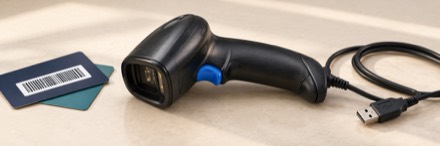
Barcode / mag-stripe reader
Acts as a keyboard, so it works with Google Sheets and Excel out of the box. Most gift cards carry a barcode on the back; a combo reader handles both that and the stripe. USB is more reliable than Bluetooth for bulk entry.
Find on Amazon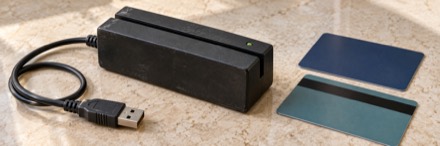
3-track USB stripe reader
Reads track 2, where the card number lives. Useful when a card's barcode is scuffed or missing. Same keyboard-emulation behaviour — swipe and it types.
Find on AmazonScanning captures the number. Balances still come from the issuer's site — but with the numbers already in a column, checking them is paste-and-go instead of squinting at plastic.
Tracking — the part that actually saves money
A spreadsheet is not optional at volume. One row per card: purchase date, store, the full card number (scanned, not typed), face value, fee paid, the card it was bought with, current balance, and the date it hit zero. That last column is what kills orphan balances.
Google Sheets is free and syncs to your phone, which matters because you'll want it at the register. Frequent Miler publishes a template worth copying rather than building your own from scratch.
Tracking the accounts, not just the cards
The other half is your actual finances. Running manufactured spending means several credit cards, a checking account moving unusual volume, and a points balance across half a dozen programs. It gets hard to answer basic questions — am I near the $25,000 Ink cap? Did that money order actually clear?
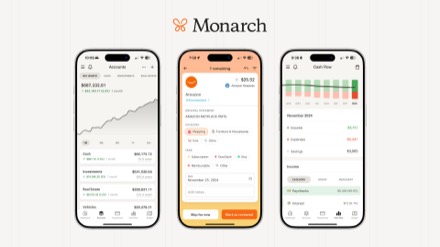
Monarch Money
The most credible Mint replacement. Connects your cards and bank accounts in one dashboard, handles multiple cards well, and its category rules cope with the fact that "Staples $1,807.95" is not really shopping. Around $99/year.
Visit Monarch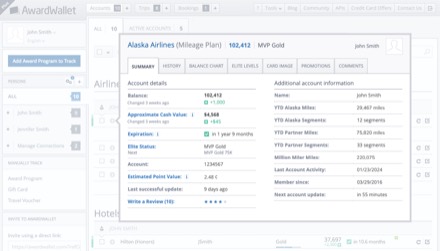
AwardWallet
Tracks loyalty balances and expiry dates across programs, which is the thing a budgeting app can't see. Free tier is genuinely usable. If the points are the point, this is the one that matches the hobby.
Visit AwardWalletA spreadsheet
Honestly: for the gift cards themselves, nothing beats a sheet you control. Paid apps track accounts well and individual gift cards badly. Use both, for different jobs.
See a templateThe tool that matters most is a card
All of the above saves you tens of dollars. The card you pay with decides whether the exercise is worth doing at all — at 5x versus 1x, a $1,800 run is the difference between 9,000 points and 1,800. The full comparison is on the dashboard.
Amazon links on this page are affiliate links — if you buy through them this site earns a small commission at no cost to you. The Monarch link is a partner link on the same terms. AwardWallet, Frequent Miler and the spreadsheet template are linked because they're useful; there's no money in those.